ChickenSense
A low-cost deep learning system that estimates broiler feed intake by listening to pecks with piezoelectric sensors.
- 92%pecking-event accuracy
- 91%F1 score
- 8 ± 7%error on daily feed intake
- 19 daysof 24/7 recordings
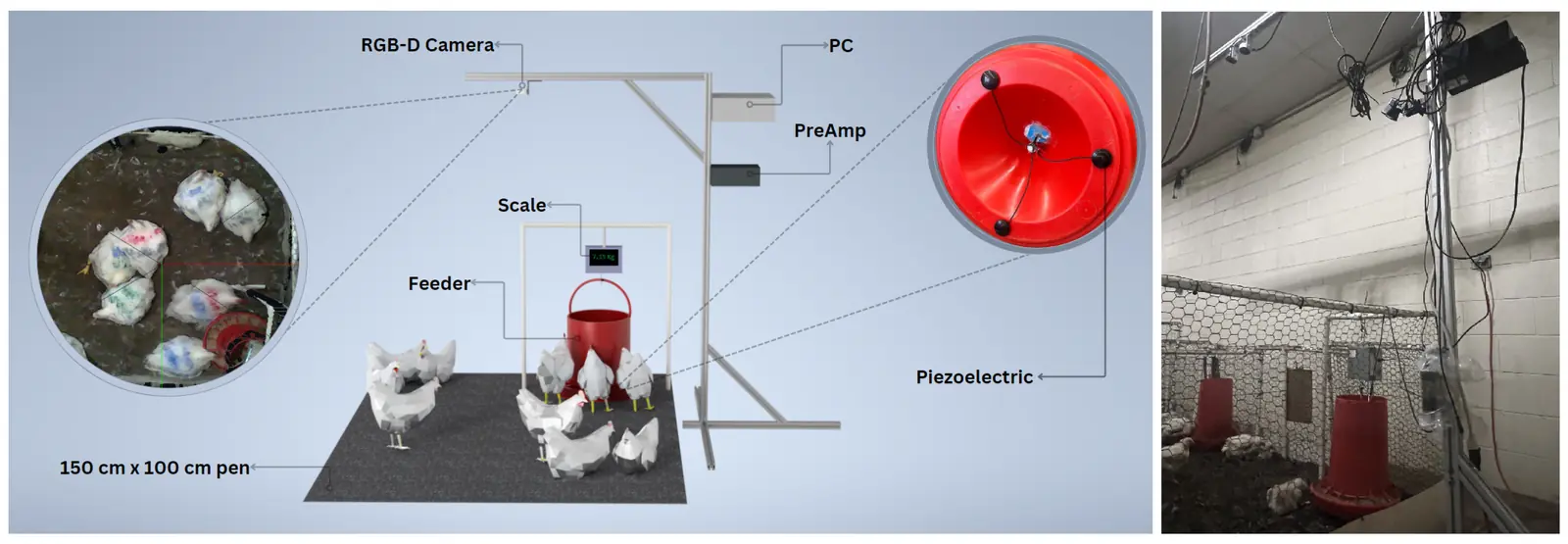
Knowing how much each flock eats is one of the most useful signals on a broiler farm, but feeder scales are expensive and hard to deploy at scale. ChickenSense estimates feed intake from sound instead: piezoelectric sensors attached to the feeder pick up the vibration of every peck.
Method
Signals were recorded around the clock for 19 consecutive days. A labeled subset split events into two classes: feed-pecking and non-pecking (vocalizations, anomalies and silence).
- Each signal is cleaned with a noise-removal algorithm and a band-pass filter.
- Two views are extracted: a spectrogram and the signal envelope.
- A dual-branch, VGG-16-based CNN learns 2-D features from the spectrogram and 1-D features from the envelope, followed by a binary classification head.
- The trained model is run over the full recording, and detected pecks are converted into estimated feed consumption.
Results
The classifier separated pecking from non-pecking events with 92% accuracy and a 91% F1 score. Compared with scale measurements, daily feed intake estimates had an 8 ± 7% mean percent error. Hourly estimates reached an R² of 0.71 and a Pearson correlation of 0.85.
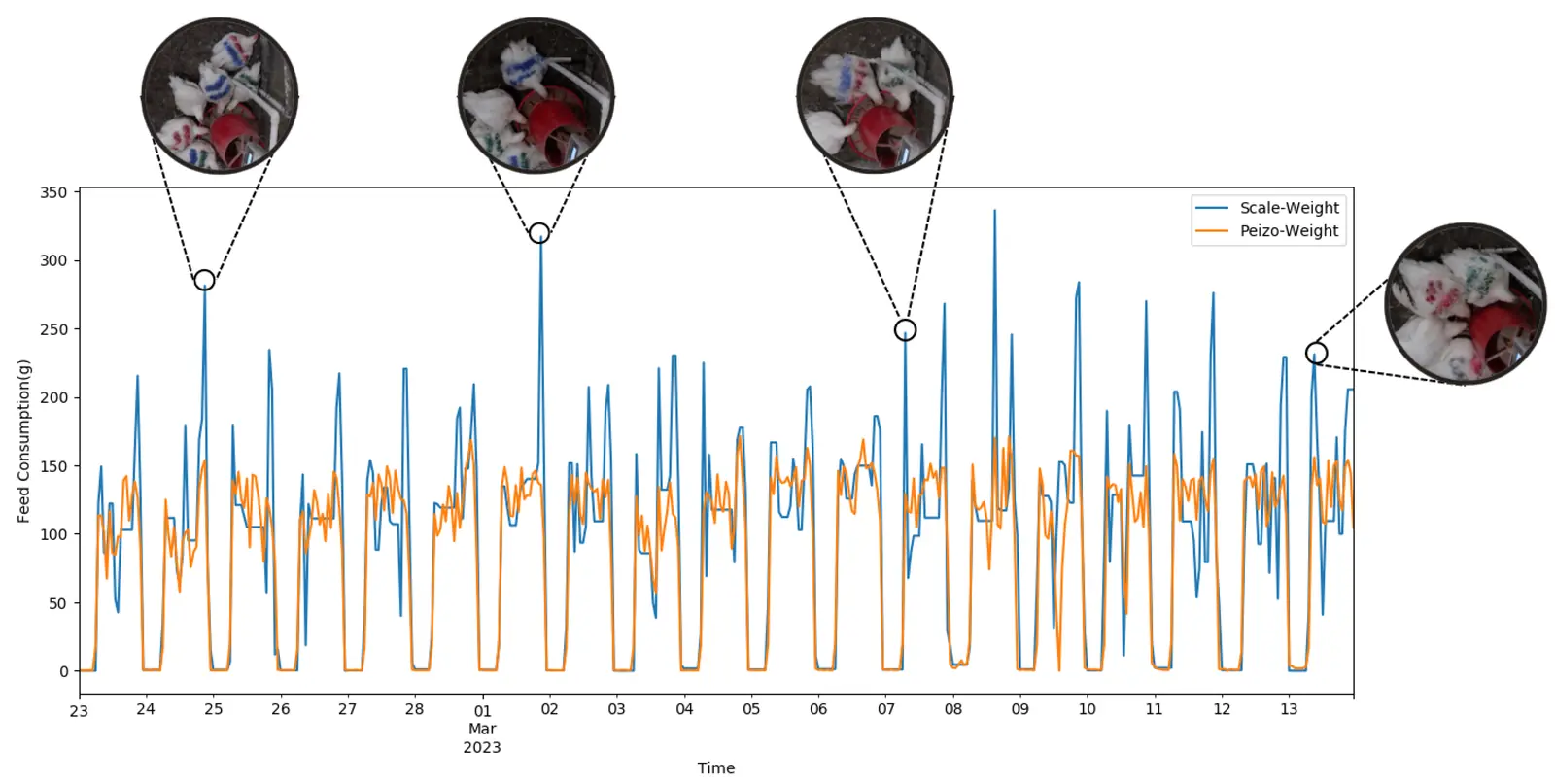
Because the hardware is inexpensive and works per feeder, the approach has the potential to be implemented in commercial farms.
Citation
@article{amirivojdan2024chickensense,
  title     = {ChickenSense: A Low-Cost Deep Learning-Based Solution for Poultry Feed Consumption Monitoring Using Sound Technology},
  author    = {Amirivojdan, Ahmad and Nasiri, Amin and Zhou, Shengyu and Zhao, Yang and Gan, Hao},
  journal   = {AgriEngineering},
  volume    = {6},
  number    = {3},
  pages     = {2115--2129},
  year      = {2024},
  publisher = {MDPI}
}