ChickenVerse
An open, large-scale multi-task dataset for chicken detection, instance segmentation, and behavior recognition.
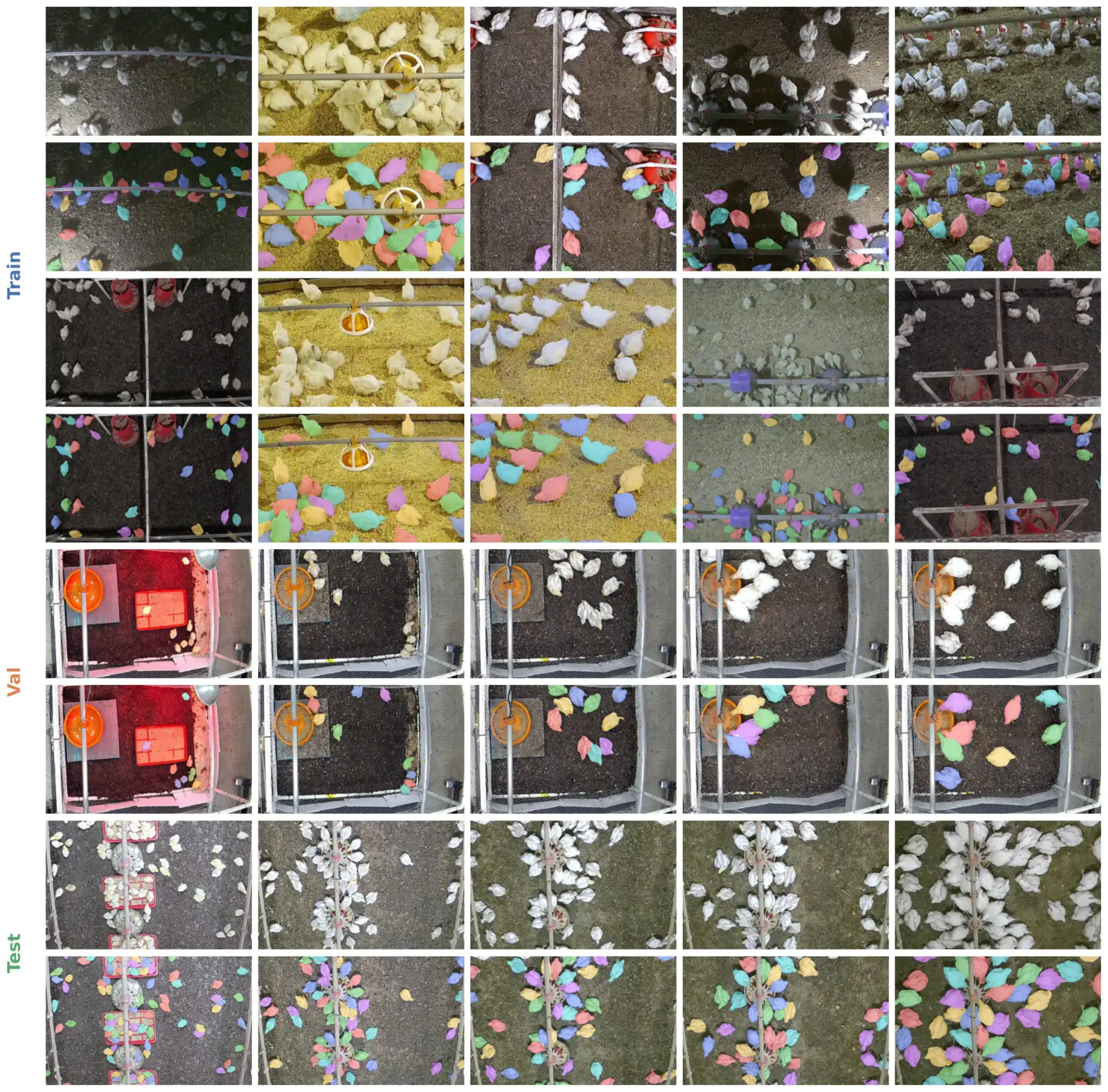
- 6,539annotated images
- 153,764bird instances, box + mask
- 15,250single-bird video clips
- 15behavior classes
- 5poultry facilities
ChickenVerse is an openly released dataset for computer vision in broiler welfare monitoring. It combines imagery and video from five poultry facilities into two complementary sub-datasets, ChickenDet and ChickenAct, each shipped with recommended train/validation/test splits and evaluation protocols.
Most poultry vision datasets come from a single farm, so models trained on them rarely survive a new barn. ChickenVerse is split by facility on purpose, so the reported test scores measure how well a model transfers to a house it has never seen.
ChickenDet: detection and segmentation
ChickenDet is a COCO-format dataset in which every bird carries a mutually consistent bounding box and pixel-level mask. Frames were sampled from overhead recordings at five-minute intervals to maximize visual diversity, and masks were labeled in CVAT with SAM 2 assistance.
The training set spans multiple farms and camera geometries, validation comes from the JARTU research pens, and the test set is a fully held-out commercial broiler house (F4).
| Split | Images | Instances | Mean per image |
|---|---|---|---|
| Train | 5,222 | 116,329 | 22.3 |
| Validation | 1,067 | 24,815 | 23.3 |
| Test | 250 | 12,620 | 50.5 |
| Total | 6,539 | 153,764 | 23.5 |
ChickenAct: behavior recognition
ChickenAct is a video classification dataset of short single-bird clips covering 15 welfare-relevant behaviors, such as eating, drinking, walking, resting, preening and dust bathing. Clips were produced automatically by a detect-track-crop pipeline (a ChickenDet-finetuned RT-DETRv2 detector plus a Norfair tracker) and then labeled by hand in a lightweight annotation interface.
| Split | Clips | Classes |
|---|---|---|
| Train | 11,278 | 15 |
| Validation | 1,829 | 15 |
| Test | 2,143 | 15 |
| Total | 15,250 | 15 |
Benchmarks
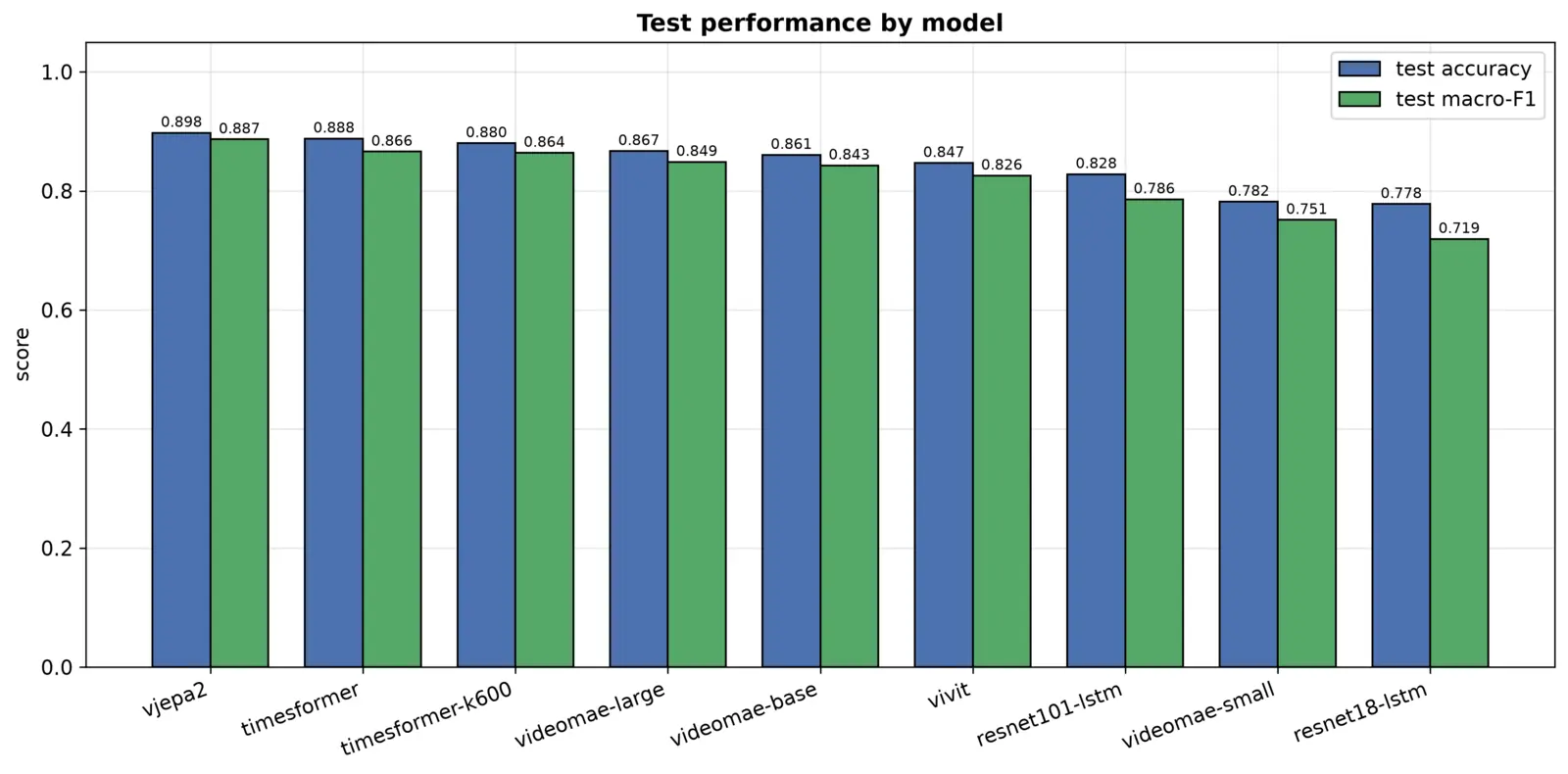
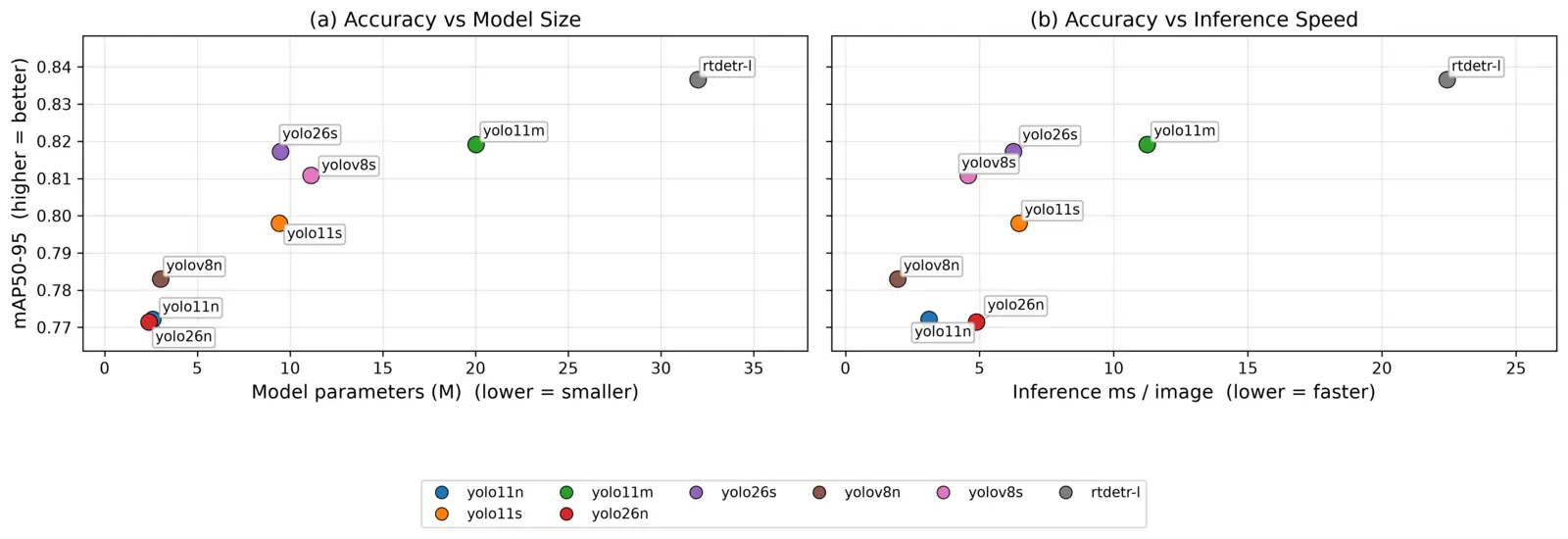
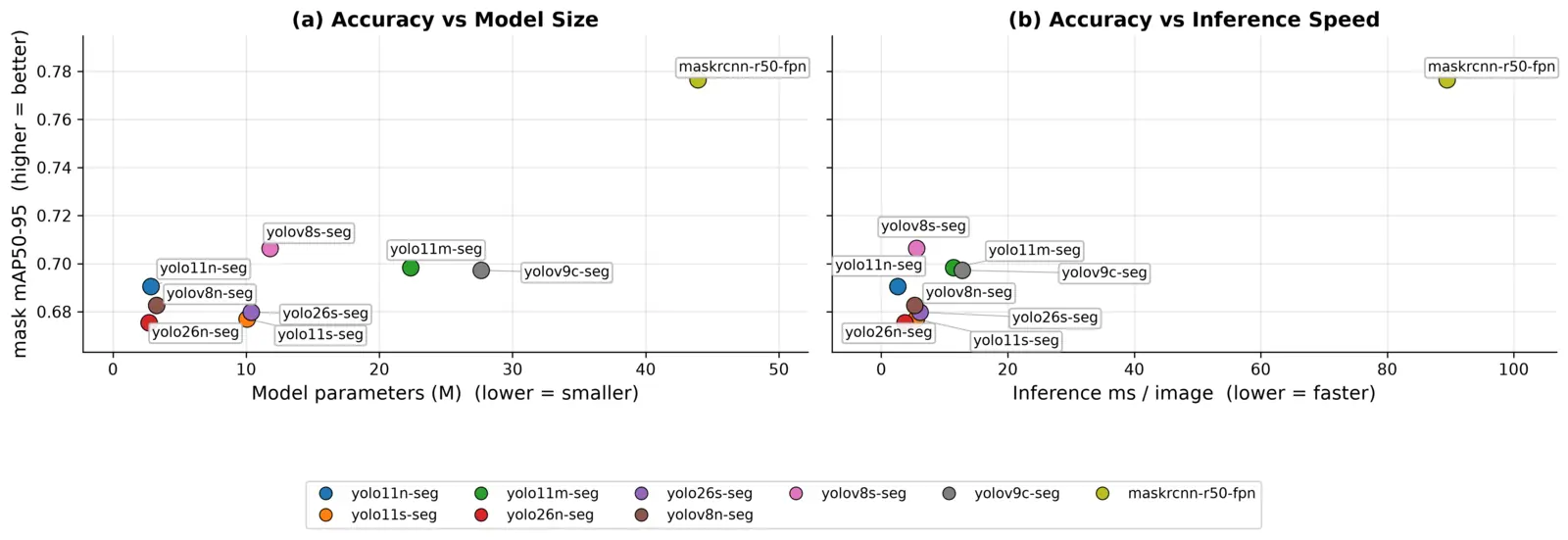
Both sub-datasets come with baselines. For behavior recognition, nine video models were compared on the held-out test split. V-JEPA 2 performed best, with 0.898 accuracy and 0.887 macro-F1.
License
The dataset is released under CC BY-NC-SA 4.0. You can share and adapt it for non-commercial purposes with credit, as long as derivatives use the same license.